Key Takeaways
- Cybersecurity is an operational necessity, not just another regulation. As vessels become more connected, cyber risks increasingly affect safety, operations and business continuity.
- Connectivity has fundamentally changed maritime risk. Satellite internet, remote access, cloud services and third-party integrations have expanded the cyber attack surface.
- Compliance does not guarantee resilience. Meeting regulatory requirements and maintaining documentation do not necessarily mean that vessels and their systems are adequately protected.
- Legacy fleets remain a major challenge. Many existing vessels rely on technologies that were never designed with cyber security in mind.
- Real resilience starts with understanding operational reality. Identifying critical assets, network dependencies and vulnerabilities allows maritime organisations to prioritise practical security measures and build meaningful compliance around them.
Author: Charalampos Ligoutsikos – GRC Manager, ThreatScene
Introduction
If there is one complaint heard across the maritime industry today, it is that shipping has become increasingly regulated.
Over the last fifteen years, shipping companies have had to adapt to a continuous wave of new requirements. Environmental regulations have transformed fuel management and emissions monitoring. Ballast Water Management systems have become mandatory. Electronic Chart Display and Information Systems (ECDIS) have fundamentally changed navigation. Reporting obligations have multiplied. Documentation requirements have expanded.
Many shipping professionals understandably feel that every operational challenge is now accompanied by a new regulatory framework, a new audit, or another compliance checklist. Against this backdrop came Cyber Security. First through the International Maritime Organization (IMO) cyber risk requirements within the ISM framework. Then through TMSA, DryBMS, BIMCO guidance, marine insurance requirements, class society requirements, and more recently through IACS Unified Requirements addressing cyber resilience of shipboard systems and equipment.
The obvious question therefore follows: Is cyber security addressing a genuine operational risk, or is it simply another layer of bureaucracy added to an already overregulated industry? To answer this question, we must first understand how shipping itself has changed.
When Ships Were Truly Islands
Historically, vessels were isolated environments. Communication with shore was expensive, bandwidth was extremely limited, and connectivity existed primarily to support operational necessities. Satellite communications were largely confined to voice and low-volume messaging. The Master communicated with the office through email and satellite phone, while crew welfare communication was generally limited to occasional calls home.
Operationally, vessels were designed to operate independently. Critical equipment was either standalone or connected only within local shipboard networks. The cyber-attack surface was small because the ship itself was largely disconnected from the wider digital world. In many respects, the industry’s strongest cyber security control was simply isolation.
The Digital Transformation of Shipping
Over the last 15 years, this model has changed dramatically. The arrival of technologies such as VSAT, Fleet Broadband and more recently Starlink fundamentally altered the economics of maritime communications. Bandwidth became increasingly available and affordable.
At the same time, business requirements evolved. Environmental regulations created significant reporting requirements covering:
- Fuel consumption
- Emissions monitoring
- Energy efficiency indicators
- Operational performance metrics
Owners sought greater operational visibility. Data analytics became a competitive advantage. Remote vendor support became common for increasingly sophisticated onboard systems.
Crew expectations also changed. Today’s seafarers expect internet access, video communications, messaging applications and social connectivity. In many cases, these services are considered an important component of crew welfare and retention.
The result is that ships are no longer isolated assets operating at the edge of a company’s infrastructure. They have become interconnected extensions of the enterprise.
The New Reality: Cyber Exposure Is No Longer Optional
This transformation created significant operational benefits.
- Office and vessel collaboration improved.
- Remote troubleshooting became possible.
- Operational data became available in near real time.
- Decision-making became faster and more informed.
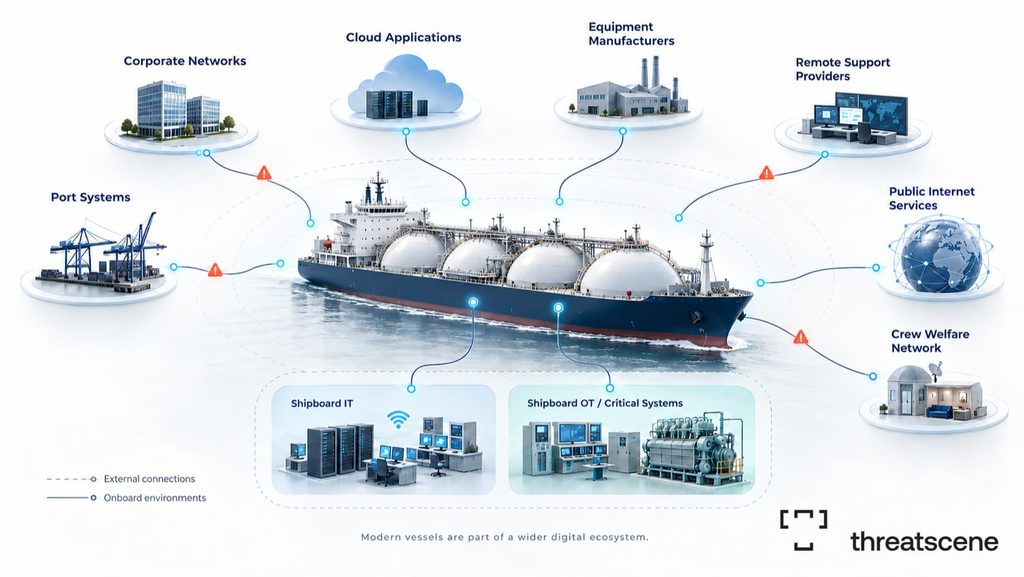
However, these advantages came with a hidden consequence. The cyber barrier created by isolation disappeared. A modern vessel may simultaneously connect to:
- Corporate networks
- Cloud-based applications
- Equipment manufacturers
- Remote support providers
- Port systems
- Public internet services
- Crew welfare networks
As these connections increase, so does risk. A vulnerability within an office network can affect vessel operations. A compromised vendor account can become a pathway into critical shipboard systems.
An infected crew device can create exposure if network segregation is inadequate.
The vessel is no longer vulnerable only to failures onboard. It is potentially exposed to weaknesses across an entire digital ecosystem. This is why cyber security is fundamentally different from many other compliance-driven initiatives. It is responding to a genuine change in the way vessels operate.
The Problem with the Regulatory Journey
This does not mean that the industry’s regulatory response has been perfect. In many respects, cyber security entered maritime regulation from the top down.
The first major requirement was the inclusion of cyber risk management within the ISM framework. Management companies and vessels were required to assess cyber risk, establish controls and demonstrate compliance. This created a difficult situation. The industry was asked to manage cyber risks associated with systems that were often never designed with cyber security in mind. Many legacy Operational Technology (OT) systems prioritised availability and functionality over cyber resilience. Some continue to do so today.
As a result, organisations often focused on producing policies, procedures, assessments and records because these were the most visible audit artefacts available. Compliance became measurable. Security did not necessarily improve at the same pace. The danger is that organisations begin viewing cyber security as a documentation exercise rather than a resilience exercise.
The Challenge of Legacy Fleets
The introduction of IACS requirements for cyber-resilient equipment and ship construction was an important step forward. New vessels are increasingly delivered with stronger cyber security requirements incorporated into design, procurement and integration processes.
However, shipping remains an industry with long asset lifecycles. Many vessels currently operating worldwide were built long before cyber security became a design consideration. Consequently, the industry now manages two realities simultaneously:
- New vessels built with increasing cybersecurity requirements.
- Existing vessels operating with legacy technologies and architectures.
Cyber threats do not distinguish between the two. A twenty-year-old vessel connected to modern communication systems faces many of the same threat actors as a newly delivered vessel. The risk landscape remains common, even if the technical foundations differ significantly.
Moving Beyond Compliance
The real question is not whether companies should comply. Compliance is mandatory. The real question is whether compliance or resilience becomes the objective.
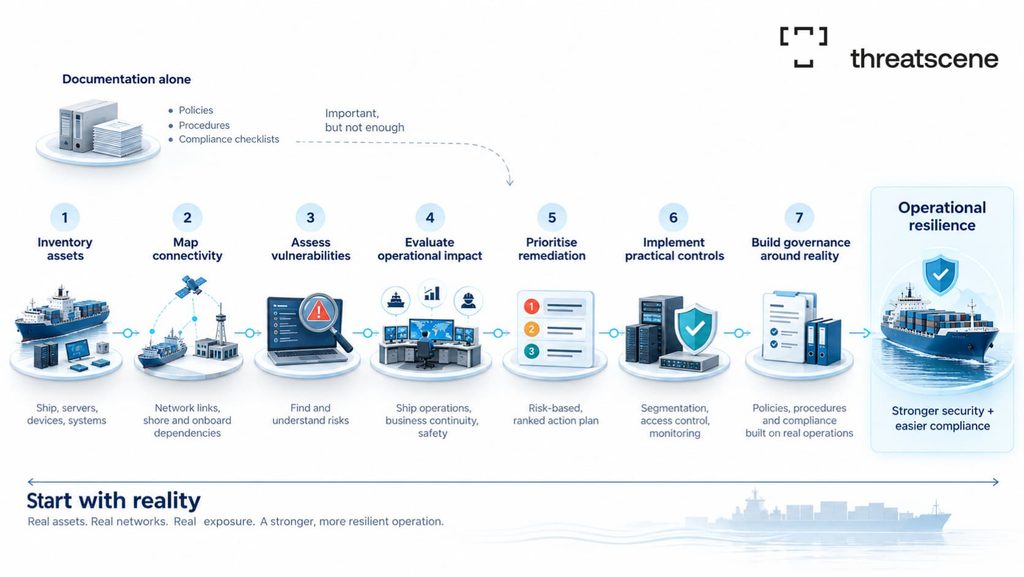
Too often organisations start by developing policies, procedures and governance frameworks and only later attempt to understand what actually exists onboard and ashore. This frequently produces controls that look impressive on paper but are difficult to implement in practice. A more effective approach is often the reverse.
Start with Reality
- Identify and inventory systems onboard and ashore.
- Understand network connectivity and dependencies.
- Assess vulnerabilities and exposures.
- Evaluate likely operational impacts.
- Prioritise remediation activities.
- Implement practical controls.
- Build governance, policies and procedures around actual operational conditions.
This produces a governance framework grounded in reality rather than assumption. The result is both stronger security and easier compliance.
Turning Compliance into Resilience
The maritime sector does not need more paperwork. It needs practical methods that help operators understand risk, prioritise investment and improve resilience. Frameworks that translate cyber security into operationally meaningful activities are far more valuable than additional documentation requirements. Frameworks such as Threatscene MARINE can help organisations follow this approach, focusing first on operational reality and resilience, with compliance emerging as a natural outcome.
When implemented correctly, cyber security becomes neither an audit exercise nor a compliance burden. It becomes part of operational safety. Just as navigation, engineering and environmental protection evolved to address changing realities, cyber security is responding to a fundamental transformation in how ships operate.
Conclusion
Cyber security in shipping is not another regulatory trend destined to fade away. It is a direct consequence of the industry’s digital evolution. The moment vessels ceased to be isolated islands and became interconnected operational platforms, cyber risk became an unavoidable reality.
The challenge for the maritime industry is therefore not deciding whether cyber security matters. That question has already been answered. The challenge is ensuring that compliance serves security rather than replacing it.
Organizations that begin with understanding their assets, networks, vulnerabilities and operational dependencies will build stronger foundations than those that begin with documentation alone. In the end, resilience is not achieved by having another manual sitting on a shelf. It is achieved by understanding how vessels actually operate, securing the technology that enables those operations, and embedding cyber security into everyday decision-making both onboard and ashore.
That is not compliance. That is operational risk management for the modern maritime era.