“They didn’t just sink ships, they sank systems.”
That’s how one maritime executive described the wave of ransomware, data theft, and OT-targeted intrusions that rocked the sector over the past 12 months.
In 2024, cyberattacks on the maritime industry nearly doubled.
Cargo carriers, port terminals, and even small fleet operators are now prime targets.
The average breach in marine transport now costs $4.4 million, with consequences that ripple far beyond the ship’s hull.
And while the seas may look calm from the bridge, the digital battleground below deck is heating up.
In this edition of The Threat Brief, we chart the most urgent cyber threats facing the maritime industry, explore the actors behind them, and break down what real cyber resilience looks like at sea.
Maritime Cyber Threats By the Numbers
The maritime sector is now among the most attacked critical industries globally. While its core operations rely on steel, cargo, and propulsion, its risk exposure lies in something far less visible: data, systems, and connectivity.
Here’s what the latest intelligence shows:
Attack Frequency & Industry Exposure
- 31% of maritime organizations reported a cyberattack in the past year, nearly double the rate from just five years ago (17%)
- Transportation (including maritime) is now the 2nd most targeted sector in Europe, ahead of banking, trailing only government/public agencies
What’s Getting Hit & How
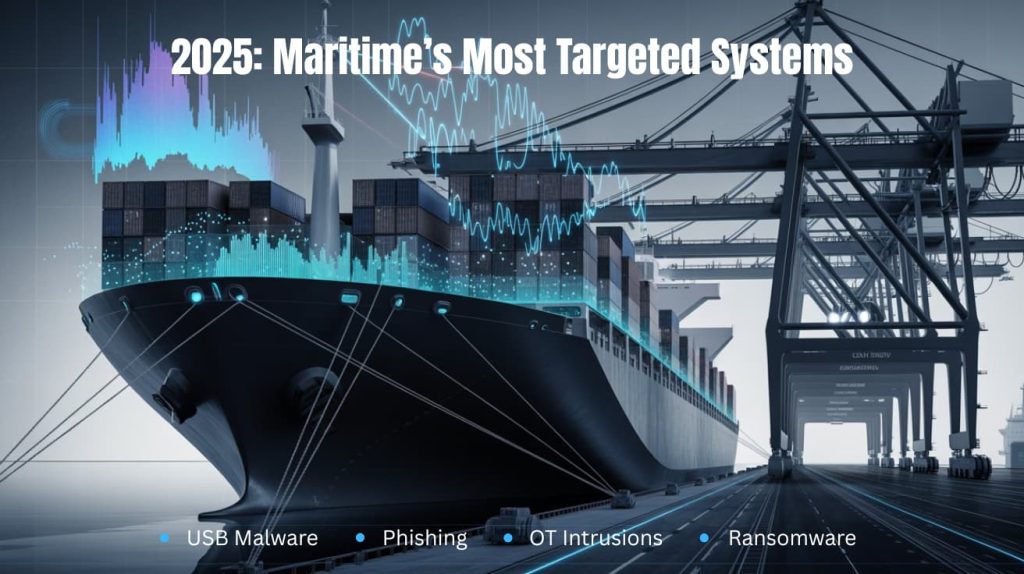
- Phishing is still the #1 entry point, accounting for ~48% of marine sector breaches
- 77% of malware infections onboard vessels originated from infected USB devices or removable media introduced by crew or contractors
- Attacks on shipboard OT systems (navigation, propulsion, cargo) are growing, blending IT vulnerabilities with real-world operational risk
The Cost of a Breach
- The average breach in transportation costs $4.4 million
- Ransomware groups are escalating extortion in ports and shipping lines, with some campaigns exfiltrating 150+ GB of sensitive data before encryption hits
- 71% of shipping executives now rank cybersecurity as the #1 business risk
These are not theoretical numbers; they reflect an increasingly aggressive threat landscape. Even small gaps, like a misplaced USB drive, can become the first step in a full-system compromise.
Who’s Behind the Breach: APTs Targeting Maritime
Cyberattacks on the maritime sector aren’t random. Many are driven by state-sponsored Advanced Persistent Threats (APTs) or criminal syndicates with financial or geopolitical motives.
Here’s a snapshot of the most active groups targeting vessels, ports, and maritime logistics infrastructure in the past 12 months:
👥 Notable APT Groups Targeting Maritime
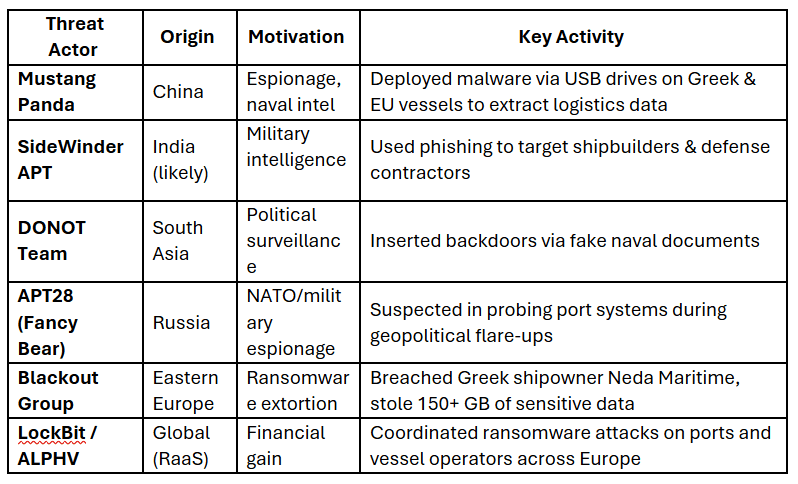
↳ Source: ThreatScene Marine Threat Intelligence Report, April 2025
Many of these actors operate with patience, precision, and political or financial agendas. And increasingly, they don’t need to blow a hole in the hull, just breach one login, one USB, or one third-party vendor.
How the Attacks Work: The Cyber Playbook at Sea
Maritime cyberattacks rarely begin with an explosion. They start quietly with a phishing link, an infected USB stick, or a login reused once too often. And by the time the impact reaches the operations deck, attackers have often been inside for days or weeks.
Here’s how they get in, stay in, and take control.
1. Spear Phishing
Emails disguised as customs forms, port schedules, or freight invoices are used to deliver malware or harvest credentials. In one recent campaign, a fake “Port Readiness Certificate” was used to gain admin-level access within minutes.
2. Infected USB Drives
77% of vessel infections involved removable media, often introduced by crew or third-party vendors.
3. Living Off the Land (LotL)
Threat actors use built-in tools like PowerShell to stay invisible while moving laterally or elevating access.
4. Credential Theft & Remote Access
Compromised credentials are used with Remote Access Trojans (RATs) to surveil or extract data quietly, often for weeks.
5. Supply Chain Exploits & C2 Beacons
Third-party software and exposed vendor connections are hijacked to establish covert command-and-control channels.
These aren’t speculative tactics; they’ve been observed in real-world attacks on Greek and European maritime operators in the last 12 months.
Resilience in Action: How Maritime Leaders Can Fight Back
Cyberattacks are now an operational certainty. But the impact doesn’t have to be.
The best maritime organizations aren’t just defending; they’re preparing. They’re aligning technical measures with real-world shipping and port workflows, and they’re using purpose-built frameworks to stay resilient.
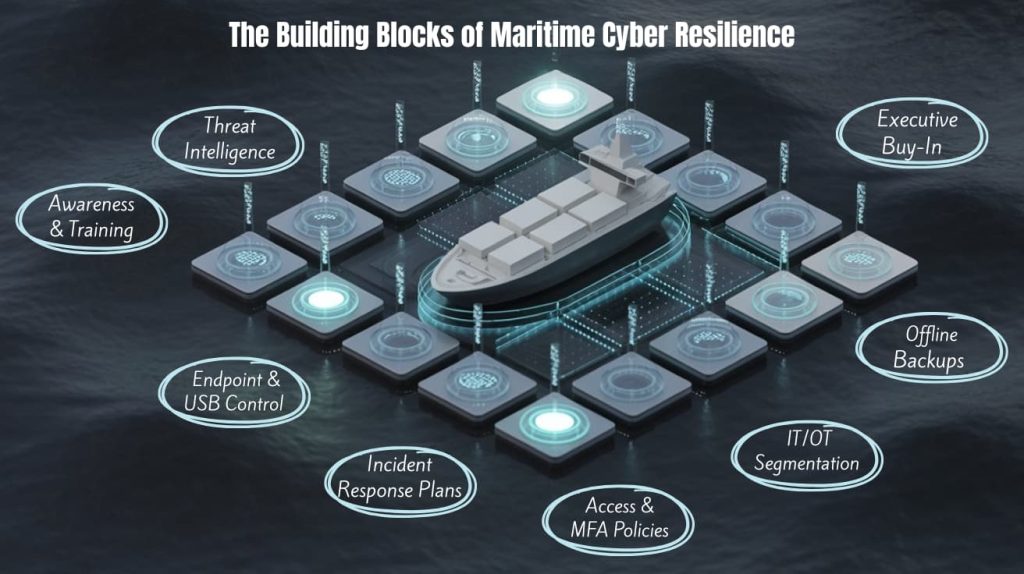
The Building Blocks of Maritime Cyber Resilience
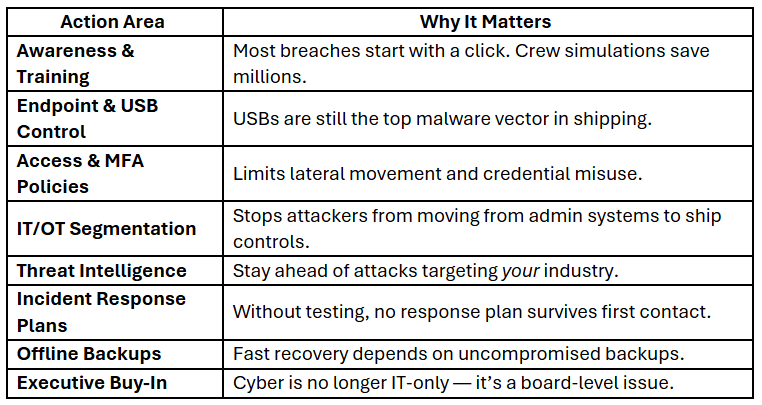
These eight building blocks aren’t standalone controls; they work best as part of a layered defense strategy.
For example, endpoint protection is only effective if supported by identity and access management. Crew training helps reduce phishing risk, but only if threat intelligence feeds keep those simulations up to date. And even the most detailed incident response plan will fail if it hasn’t been pressure-tested during an actual drill.
What ties all these elements together is a shift from reactive IT defense to proactive operational resilience.
In a maritime context, that means embedding cybersecurity into day-to-day decisions, not just within the SOC, but across procurement, bridge procedures, engineering operations, and third-party logistics contracts.
That’s exactly the philosophy behind ThreatScene’s MARINE Framework: mapping these best practices to real-world roles, risks, and regulations across vessel, port, and vendor networks.
At ThreatScene, we built the MARINE Cybersecurity Framework specifically to address these challenges. It’s designed for maritime realities, not just compliance checklists.
What it delivers:
- Full integration of IT and OT risk management
- Alignment with global maritime regulations (IMO, IACS, GDPR, NIS2)
- Audit-ready structure endorsed by Bureau Veritas
- Modular deployment across vessels, ports, and vendor chains
Whether you’re a fleet operator, port authority, or maritime tech vendor, the MARINE Framework provides a clear, actionable roadmap to assess risk, harden defenses, and strengthen response readiness without disrupting operational flow.
Developed in collaboration with the Hellenic Chamber of Shipping, the ThreatScene MARINE Framework is now available for download on their official website.
👉 Access it here: https://nee.gr/2024/11/27/the-marine-cyber-security-framework/
Wrapping up
Cyber threats are no longer abstract. They are operational, measurable, and increasingly existential for maritime players.
The difference between a disruption and a disaster? Preparation.
If your organization hasn’t tested its response to a targeted cyberattack or doesn’t know where its weak points are, now is the time to act.
Want to know how your organization would hold up under a targeted maritime attack?
Let’s simulate it together. Book a consultation with our team today.
Curated with purpose, delivered with precision — The ThreatScene Team
PS. The future of secure shipping starts now, and it’s strong. 🌍

Sources Referenced
ThreatScene Marine Threat Intelligence Report (April 2025)
IBM Cost of a Data Breach Report 2024
CrowdStrike Global Threat Report 2025