By Team ThreatScene
“We’ll leak your data if you don’t pay.” That’s the new reality behind most ransomware attacks in 2025.
Ransomware has evolved from a straightforward encryption scheme to a sophisticated form of digital extortion. It’s no longer just about locking files; it’s about stealing your most sensitive data before you even know the breach happened.
Today, attackers threaten to publish your stolen information unless their demands are met, turning what was once an IT issue into a board-level crisis involving legal, regulatory, reputational, and financial consequences.
This evolution is called Double Extortion, and it’s no longer a fringe tactic. It’s the new baseline.
The Rise of Double Extortion
Why backups alone are no longer enough
Over the past 18 months, double extortion has become standard practice in ransomware campaigns, and it’s changing how we think about cyber defense.
Here’s what’s different:
🔁 Then: Encryption Only
In earlier ransomware attacks, the goal was simple:
- Encrypt systems
- Demand payment for the decryption key
- Leave the victim with no access to data or operations
If you had good backups, you could often recover and avoid paying.
⚠️ Now: Exfiltration + Encryption
Today’s attackers don’t just encrypt, they steal. Before deploying the ransomware payload, they quietly exfiltrate sensitive data:
- Employee records
- Internal emails
- Financial files
- Intellectual property
- Confidential contracts
Once the data is out, the attackers encrypt your systems and deliver their message:
“Restore your files? Sure. But if you don’t pay, your data goes public.”
📊 Recent Trends
- 96% of ransomware incidents now include data theft
- Attackers often operate for days or weeks undetected
- More than 50 active ransomware groups were tracked globally last year, most using this exact model
So even if you’ve done everything “right” — patched, segmented, backed up — you may still face regulatory exposure, reputational fallout, and public data leaks.
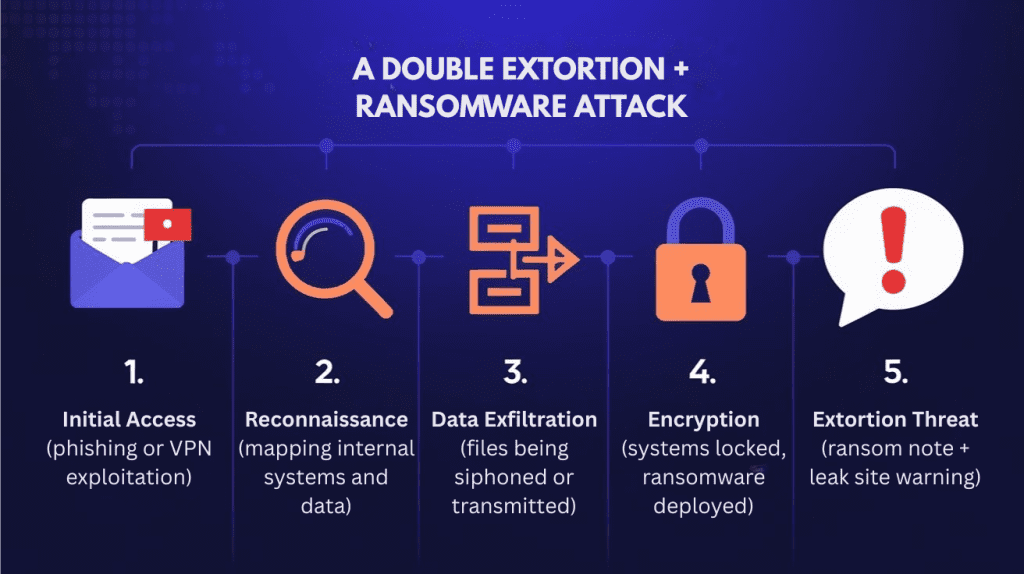
A Typical Double Extortion Attack
Let’s break down how these attacks typically unfold. The flow is methodical, not chaotic:
1. Initial Access: Attackers enter through phishing emails, vulnerable VPN gateways, or exposed remote desktop services. Increasingly, they purchase this access from underground markets.
2. Reconnaissance: Once inside, they map the environment. They look for backup servers, file storage, executive folders, and anything labeled “confidential.” Often, they blend in with normal IT traffic to avoid detection.
3. Data Theft: Sensitive files are copied quietly and exfiltrated to attacker-controlled servers. This can happen over days or even weeks.
4. Encryption & Ransom Note: Only after the data is gone do attackers deploy ransomware to lock systems. The ransom note doesn’t just offer a decryption key; it comes with a threat: your data will be published or sold if you don’t comply.
5. Public Pressure & Disclosure Risk: Leak sites on the dark web, and even on the surface web, are used to release stolen data in stages to increase psychological pressure. Some campaigns falsely attribute breaches to high-profile groups to intensify reputational damage.
By the time you see the ransom note, the data is likely long gone.
Why This Threat Is So Disruptive
Double extortion attacks succeed not because companies lack backups, but because they aren’t prepared to respond to blackmail involving stolen data.
Even organizations with strong technical defenses often find themselves vulnerable on other fronts:
Legal Risk
If the exfiltrated data includes personal or customer information, regulations like GDPR and NIS2 require breach notification. Failing to disclose in time can result in heavy penalties, and attackers know it. Some even time their ransom demands to align with mandatory reporting deadlines.
Data-related threats were among the top three most reported incidents across Europe last year, reflecting how critical this exposure has become.
Reputational Harm
Leak sites indexed by search engines mean that internal emails, customer lists, or sensitive contracts could become public knowledge overnight. This erodes trust with clients, partners, and employees, and it’s often irreversible.
Business Disruption
While encryption can halt operations, leaked data can damage competitive advantage, trigger lawsuits, or lead to regulatory investigations, especially in industries where confidentiality is non-negotiable.
What Resilience Looks Like in 2025
How modern organizations are preparing for ransomware before it strikes
Ransomware response isn’t just about recovering operations; it’s about minimizing the damage before it begins.
Today, resilience means much more than good backups. It’s about strategic readiness: detection, decision-making, and coordinated action across both technical and non-technical teams.
Here’s what that looks like in practice:
✅ 1. Detect Fast Before Data Leaves the Network
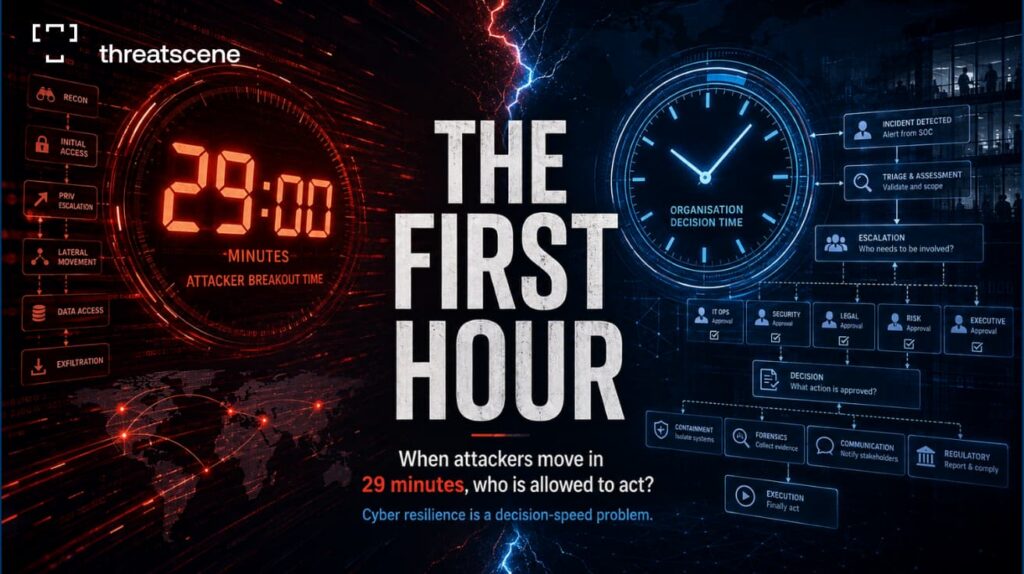
Modern threat actors are fast, stealthy, and increasingly quiet in the early stages of an attack. Recent reports show the average time from initial access to lateral movement has dropped below one hour, with some attackers acting within 51 seconds.
Organizations need to:
- Use behavior-based threat detection
- Monitor file access and data transfer activity
- Deploy deception assets to trigger early alerts
Early detection is often the difference between a minor event and a public crisis.
✅ 2. Build Resilience into Identity and Network Layers
Attackers don’t break in; they log in. Credential abuse and weak segmentation are still the most common attack vectors.
Resilient organizations:
- Enforce least-privilege access and review it regularly
- Apply strong MFA across all admin and remote systems
- Monitor for unusual behavior across user accounts and endpoints
- Segment sensitive systems to contain the potential spread
Every added control adds friction and buys valuable time.
✅ 3. Know Where Your Crown Jewels Are
Not all data is equal. Know what’s most valuable and who can access it.
- Classify your most sensitive datasets
- Map their storage locations
- Monitor and restrict access based on roles
This kind of visibility is crucial, especially in regulated or IP-driven environments.
✅ 4. Test, Don’t Assume: Response Must Be Practiced
Having a written plan isn’t enough. You must practice your response under pressure.
The most resilient organizations:
- Run ransomware tabletop exercises with execs, legal, and comms teams
- Maintain standing access to external IR support, not just a helpline
- Define clear escalation paths for compliance, legal, and notification workflows
Organizations that test regularly respond faster, more decisively, and with fewer mistakes.
✅ 5. Pair Backups with Threat Intelligence
Restoring systems is one thing. Understanding what was accessed or stolen is another.
Combine:
- Immutable, offline backups
- Threat intelligence feeds for ransomware behavior
- Forensic readiness to analyze attacker movement and scope exposure
In a double extortion event, restoration alone is only half the equation. Full recovery depends on understanding the impact and responding accordingly.
Final Insight
Organizations that train proactively, maintain active external partnerships, and stress-test their environment are the ones best equipped to contain ransomware incidents quickly and recover on their own terms.
Want to know how your organization would handle a double extortion attack? Let’s simulate a real-world scenario together and strengthen your response before it’s needed.
Book a consultation with our team today.
Curated with purpose, delivered with precision — The ThreatScene Team.
PS. Stay sharp, stay safe ✌️

Sources:
ENISA Threat Landscape 2024
CrowdStrike Global Threat Report 2025
Arctic Wolf Threat Report 2025
Microsoft Digital Defense Report 2024